See also:
- Article in "Solovetstkoe More" almanac (link coming after saleout of the almanac issue)
- Report on NSF website (Russian only)
|
Repair
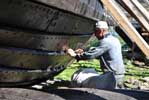
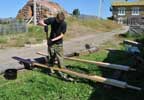
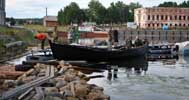
For the first time we arrived on Solovki isles on June the 8th, our team counted three --Viktor Krivonosenko, Mihail Naimark, and Vladimir Schetanov. Victor's small, but vigorous Hyndai Getz carried 150 liters of tar (extracted on Vodlozero, in Koskosalma "tar works"), dry sphagnum moss for caulking, tools, and lots of stuff. After taring the shnjaka on the inside, we turned her bottom up, caulked, and tared on the outside, too. These toils lasted till June the 13th, when we left the shnjaka to dry her fresh tar coat; and we went to Vodlozero, to make use of the time, carving new oars, blocks for tackle, etc.
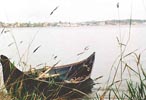
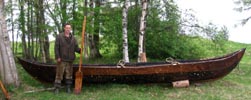
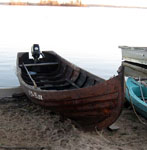
Our second visit commenced on 2nd of July, with more numerous team -- Dmitrii Varavin, Maxim Mischenko, Mihail Naimark, Alexey Prozherin, -- while Vladimir Schetanov with his wife Dina came to Solovki even earlier. During the first visit in June, shnjaka's preservation state looked remarkably good to me, -- after 7 years of exposition to elements, without tar and maintenance, I did not discover much rot. But second visit had immediately shown otherwise: bottom planking, hitherto stayng in shadow and humidity, in overturned position faced sun and air, dried and chracked, despite new and abundant tar impregnation. Second strake's edges splitted off almost by half the hull's length; close inspection revealed bad rot all along there (here rain water gathered in grooves of clincker planking). Later, when turning the hull back on level keel, we leaned it gently against a support, and rotten wood gave way silently, without crackling noise. My initial grave misappraisal of her preservation state was based on my experience with boats wear and dilapidation during hard expluatation. Shnjaka, on the contrary, decayed on the shore, without use. Symptoms looked quite differently, -- her old tar coat did not wear off, and wood under it looked nice and sound. Unfortunately, it was only thin surface crust, protected by the tar, while in the core most planks were already badly rotten.
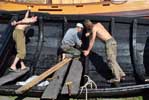
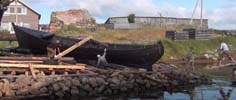
So we had nothing but to spend another week in miserable and ungrateful repairs, in hope to restore her seaworthiness for just one more season. Large wooden lathes were fitted and sewn over dangerous spots; for sewing material, we took birch withies, that grew nearby. On the other hand, our team thus gained experience and mastered boat sewing techniques with withies. Finally, our shnjaka has been launched only on 11th of July, and few more days were occupied in making new tackle, and provision of countless small things needed on a ship at sea.
|
First sailing out, 14 July.
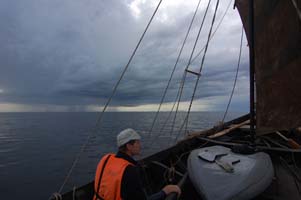
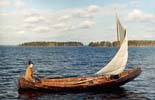
Our first sailing passed rather well, with modearete south-westerly wind. In 10 hours we have covered some 40 km in a round-trip, returning home by nightfall. Experinced also a thunder shower, and a period of calm after it. Rowing was needed only for a few hundreds of meters, on our way out between Pesya Luda iselet and rocky shoals, where narrowness of the passage permits no tacking against contrary wind.
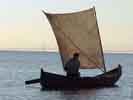
Shnjaka performed properly, as before, in her voyages in summer 2005. Her leaking was now much faster (one could expect that), and we had to do some bailing a couple of times during the trip. Though, with swelling of wood in the water, leaking was gradually becoming slower. Notwithstanding the rot, her hull was not going apart yet.
|
Our second trip, to isles Zayatskie on 16 July.
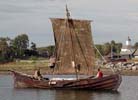
Our second trip was short, only as far as isles Zayatskie. We have arranged for our departure from Blagopoluchiya (Prosperity) haven to be simulataneous with yacht's "Phoenix" (bound for Archangelsk), to shoot some pictures and videos of sailing shnjaka form another vessel. This plan was disrupted by an impressive thunder cloud, which forced the yacht to return to the pier, and shnjaka to cast anchor near isle Igumenskii to wait through the thunderstorm. There came no strong squall, however; insted, cold fog and drizzle descended upon sea after the passing cloud .
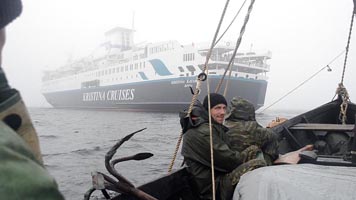
Navigating to Zayatskie by GPS, we only caught in our fog-blocked field of vision a large cruise liner, anchored in the roads beyond Pesya Luda iselet. Reaching our goal soon, we were unable to land on Zayatskie -- rapid tidal currents did not permit shuttling to the shore in our tiny inflatable dinghy. So we decided to cook and dine onboard -- we made cooking fire on alazhma, the traditional hearth of sand and stones in pomor ships. After the dinner it became too late to think about landing any more (Dina wanted to catch "Vasilii Kosyakov" boat in Solovetskii), so we set out for the return jurney.
The wind blew very lightly from east and south-east on that day, we even had to use oars at the finish, as the wind ceased completely.
|
Anzer, 17-20 July.
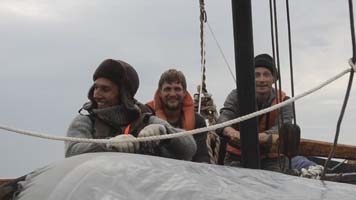
Our longest trip - to isle of Anzer - started on July the 17th in skirting around northern coast of Bolshoi Solovetskii island, and ended on 20th around Muksalma isles and southern part of B.Solovetskii.
Departure time has been planned accordingly to weater forcast and tide, but we did not keep the plan, departing late for a couple of hours, as late as about noon. Consequently, the start was comfortable, with nice weather, fair light breeze and favorable tidal current; but we have already missed time to pass around the northern end of B.Solovetskii with these comforts. Near Sosnovaya bay the weather suddenly gave several random gusts from different directions, and then died down. Tide, too, was soon due to turn against us. Whole night (it is light till morning in summer near polar circle), we tried to tack in almost complete calm, but mostly we have advanced by rowing - for about 15 km, and it came without unpeasant exhaustion. Anchor has been cast at 3 in the morning behind cape Kenga on Anzer. Once more our inadequate dinghy and its toy oars permitted no landing in strong currents, which threatened to carry the dinghy away into the open sea.
In the morning on July the 18th, we avoke to see stormy N-O wind, from which we were sheltered by cape Kenga rather badly -- at high tide surf rolled over shallows around the cape, while currents happened to be remarkably stong here. The currents turned our vessel - despite the pull of anchor cable - sideways to the trough and wind, so rolling and seeling grew really big. Our tired crew just boiled tea on alazhma, and proceeded with sleeping and rest till evening. Only about 10 in the evening we seized a moment when the current slackened to turn around, together with weakening of the wind, and rowed cautiously closer to the shore, and, at last, landed in the dinghy. A long rope's end was carried to the shore and fastened there, to provide a safe guide for the dinghy, in case of strong current and wind. Cellular coverage on the island's top is good enough, but the Internet was apparently down -- only too often on Solovki. We have had a hard time getting weather forcast through SMS messages: weak and unstable breezes tomorrow. Meanwhile, in the night, it started to rain fast, Dina and Vladimir soaked to the skin and were hospitably invited by a local forester into his cabin, others sought shelter in shnjaka.
On 19th we sailed out on our return way, with nice weather and a very light breeze, better to say short unpredictably directed puffs, which humiliated all our calculations in tacking and traversing. So by the evening we found ourselves only at the turning point near wast shoals to the East and South of Malaya Muksalma isle. There we cooked and dined, both at anchor and adrift, and finally took up oars, to cover another 10 km towards Pechak cape. Rowing came easily enough, without uncomfortable fatigue. After midnight a fair wind from N-E has risen, that allowed us to round Pechack and Zayatskii rapidly, and early in the morning we started long tacking in approach to Solovetskii settlement, which now lied upwind from us. It required three long tacks against ever freshening N-E, to get to the enrtance into Prospertiy bay, between iselet Babii and Batareinyi promontary, -- a very shallow and stony passage for small boats only, it is marked with log cribs on rocks on both sides, nested into which prominent crosses stood in old time. The contrary wind grew so fresh by then, that all our strength on oars was required to maneuver through this passage, succeding on the second try, keel grinding against stones. Short stretch till our pier on Seldyanoi nos also took our full power rowing against the wind.
In general, this three-day sailing ended on 20th of July safely and without complications, though it turned not so comfortable. We had no much luck with the weather, but, on the other hand, shnjaka has no sufficient habitability for this large crew in long voyages. Some carefully considered equipment would help -- adequate dinghy, of course; then watertight containers, tents, suitable food, satellite communcation and weather forcasts; and, not the least -- punctuality of all crew members regarding departure time and the like.
|
Sailing for cameras, 21July.
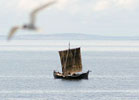
Next day another short sailing was undertaken with the purpose of filming, we just exited the haven, described a circle beyond Pesya Luda, and came back home. Video and photo was filmed both from following inflatable powerboat, and from Pesya Luda top with telescopic lense at a long distance. Unfortunately, the wind was very weak, and gave no opportunity to shoot a
good sailing footage. A for the rest, it was a warm sunny day, we made all our round trip under sail without rowing at all, -- so called "gentle sailing".
On 22-23th we dismantled all tackle and mast, and stowed them into the museum warehouse. Shnjaka's hull was pulled partially ashore, and the crew departed home from Solovki.
|
Sailing on 22th August.
Our third crew staff -- Dmitrii Pankratov and myself -- appeared on Solovki on August the 20th. At low ebb we managed to caulk the bottom of pulled ashore shnjaka and stop the cracks, so she leaked much less afterwards, almost as slow as when new, in 2004-05. By 22nd she was again waterborn and completely rigged and tackled, and we sailed out in a very calm morning. Whole day was quite still, wind sufficed only to reach Belushii nos (white whales where already gone at this season), then to come to Topy iselets and return to the settlement with stern wind. This August day felt warmer than most of July.
Next day was, on the contrary, stormy and rainy. We spent it in museum in Solovetskii kloister, studying birch bark and skinboats (similar to canoes and umiaks, but European and Asian origin) made by Alexander Shutukhin, aspen duguot, seal-hunting ice boat, and other things there.
|
Good cruise on 24 August, solar ice halo, pulling into museum building.
Our last cruise happened to be the luckiest, with steady W-S-W of sufficient strength, and using tidal currents to our profit, we have covered c. 75 km over closed circular route, in ~12 hours. (linear segments connecting GPS waypints total to 73.3 km). After rowing between cribs at Babii isle passage, we hoisted the sail, to change the tack first at 8 km to N-W of Sennuhi islets. Then sailed towards Kouzova isles, passing at 6 km distance from Oleshin isle, and further to N-W-N until we were somewhat higher to the North then Sekirnaya Gora hill and lighthouse. Then, by the end of the day we turned and sailed home fast with the stern wind, sometimes making up to 12 km/h. Earlier, on close-hauled courses our speed at times reached 9 km/h.
This was also the day of famous ice solar halo on Solovki, (see also 3D model created by Urii Gnatyuk). We were lucky to wach the phenomenon above the sea, right around our mast.
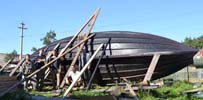
So shnjaka's sailing in summer 2013 ended, but one job was left to do -- pulling her ashore and into the building of Solovetskii maritime museum. It was not an easy thing for two people with hand windlass, and it occupied our last three days on Solovki.
|